As a software developer, most of the literature I've come across over the years, deals with accounting equations, and definitions of assets, liabilities and equity, in its fundamental form. The world of accounting revolves around these entities. However, there are Fundamental Accounting Concepts, which are not so well explained.
The book [1], which I believe is a seminal work addressed for the needs of SME owners, and directors, brings a lot of clarity and explained these concepts in detail.
Preparing this article, I can spot that the wording of the concepts and explanations have changed, I've found that the normative text started as SSAP2, through FRS18, and FRS102.
I've heard the principles over the years, in personal communications with our company accountants, and also in the consulting sessions, which we attended over the years while working on ProudNumbers.
As the author of the book states very poignantly on pg. 26, we become a nation driven by the profit and loss account. The up-to-date explanation, which became famous in the world of alternative media news, talks about a profit-based economy vs. purpose-based economy [2].
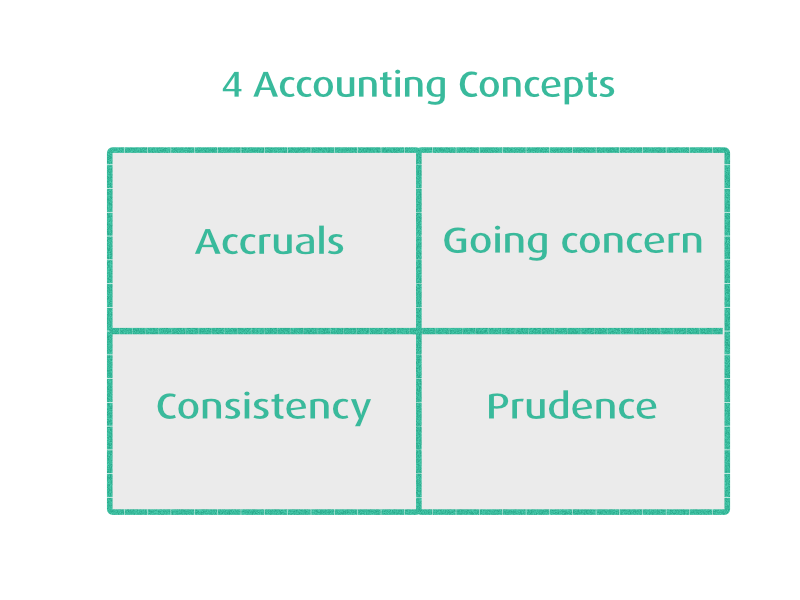
Let us then look at these fundamental principles:
✅ Accruals (or matching) concept
This is to say that the accounts contain income and expenditure on an arising basis. The term accounting period is introduced here - mostly a month of the year - and we are looking at the fact whether the item has been consumed by the business or sold in that month. It is most likely that the item sale price has not been received, similarly the cost of item consumption can be paid later. So we do not produce accounts based on the cash, which has or has not been received.
The collection of cash is critical, and we can see that following the accruals’ concept, we measure the profit and loss account, however, the collection of money could happen much later. This is a key learning from this, and as business owners we need to be aware about the principal nature of this concept used.
✅ Going concern concept
When the accounts are being prepared, it is assumed that the company will continue trading into the future. The going concern assumption must be included, as otherwise it could be very complicated to show the truthful value of assets, for example, plant and machinery.
✅ Consistency concept
This is a relatively simple, self-defining concept. Accounting policies should remain consistent from year to year. As the author mentioned in his book, consistency is a concept easy to explain but hard to enforce.
✅ Prudence concept
Does conservative billing term mean the same thing as prudency? The profits should not be overstated. Combined with consistency, it makes complete sense.
But, looking at past big scandals, I think that companies do not always follow this principle in detail.
References:
[1] Mastering Financial Management, Brookson S., 1998, London [2] Podcast program, Berletic, B., New Atlas, 2024-2025