Departmental Accounting as an underused concept in the SME-s usage of accounting programs. Most businesses have some organisational structure, built around product or services, and it is underpinned by general administrative, marketing and sales functions.
The easy way to capture the organisational structure for a business in its financial reporting is through the use of departments.
The departments are defined tags, which are attached to transactions, when entering them into a double entry bookkeeping journal.
In Sage 50, these tags can be set up, and number codes are used. As it happens, these numbers will exist in perpetuity, but as business conditions change, a business grows, so do the departmental numbers, and sometimes it can get confusing, especially when a need to retire the department arises.
The departments are also called cost centres in the literature, and I believe that this term better explains what they represent. The cost centres associated with the production phases of the product give a better understanding of how costs flow from one phase to another.
The real problem comes to life where the indirect costs need to be allocated across all the products produced by a business.
This is more pertinent for the situation when the products are unequal, in terms of their complexity, or production procedure.
Knowing what is going on the shop floor and having the right apportioning figures in mind does help to get a good picture in terms of net-profit margins for the departments.
This is even more challenging for overheads, where some of our clients use a notion of Central Office, which is a separate cost centre. The other option is to apportion overheads between the product cost centres.
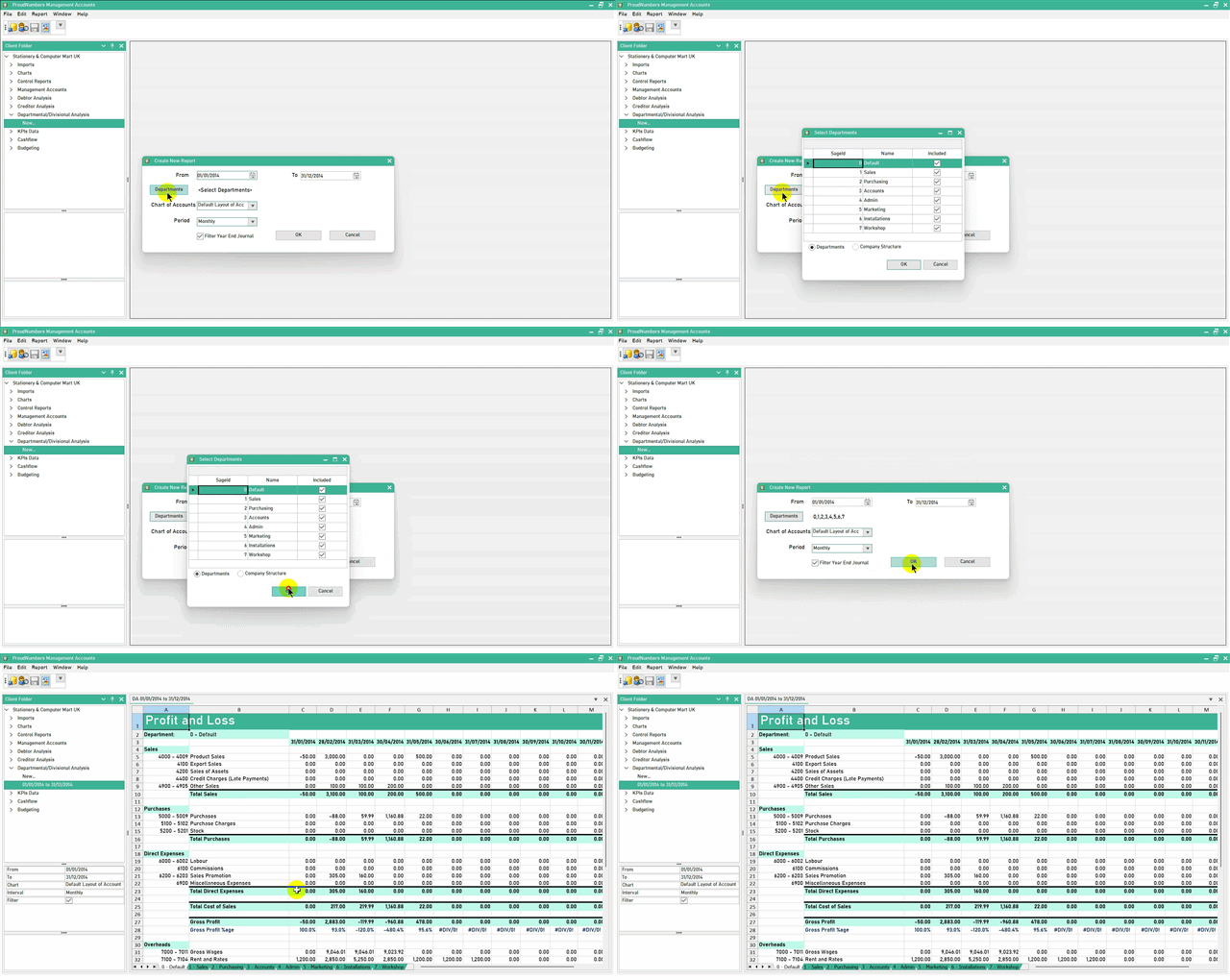
Coming back to reporting, it is possible to report for the departments in the monthly/weekly /bi-weekly breakdowns, so the real profit margin can be seen at each time interval. This could shed some light for the management team on the costs of inputs, and direct costs for the departments.
ProudNumbers offers an additional feature where the departments imported from the Sage 50 can be grouped into divisions.
This feature allows grouping together different departments, thus saving the management time, especially where there is clarity that 3 -4 departments contribute to the bigger product.
Again - this allows more effectively to work with overheads, as the overheads can be allocated only to some departments, knowing that they will bring up correct figures in the divisional reports.
This structure is applicable in Bdugeting & Forecasting module, thus giving further management control over the business, and planning the right resources, and tactical, and strategic decisions.
Overall, quality bookkeeping SOPs are needed to report correct figures, but no tool can replace a good accountant, organising the financial department properly.
In the past years, we have very much forgotten the human factor of accounting, but right tooling actually allows humans to do their job better, faster, and easier. Shall we say that ProudNumbers is truly pro-growth tool, so much being asked nowadays economy, and politics?
References:
- Management Accounting for Decision Makers, Atrill, P., McLaney E. , Pearson Education 2009, Harlow, Essex