The idea of this post is to recap some of the key ideas from my previous post on Estimating and Budgeting.
As most of us should, and hopefully will transition from that one figure estimating and budgeting mindset into a concept of a range with minimum and maximum cost for each line on the budgeting work sheet.
As we call for simplicity, let's now try to think about an instruction set to create a best case/ worst case scenario estimate for our project.
In the first instance we will need to think about splitting a bigger project into smaller manageable chunks.
Once we split the project into tasks and line them up in the spreadsheet, we need to think about task overrun.
Having said that, we may think about each task and first enter our best case figure into the spreadsheet. The best case figure is usually based upon our previous experience or knowledge of the same type of activity in the past.
Once we have that best case number entered onto the worksheet, then we need to think to start about the confidence level on this particular piece of work. If our confidence level is absolutely high, and we know that this is the same task as has been done many times before, we can map our confidence level against the risk associated with the task overrunning and assign an appropriate percentage for it.
Let's assume that our confidence level is very high. Therefore, we allocate 10% reserve for the budgeted cost of the task.
So we're now ready to calculate the total amount of money budgeted say
£1000 for the best case and the worst case scenario is £110.
Now things can get complex very quickly.
Let's assume that our confidence level varies somewhere around the 70% mark - so in that case we would add a reserve 30%.
If our confidence level is low, our reserve inevitably must be very large too, and we use 100% or more dependent on what type of project we are working on and what is the novelty factor for us.
So essentially we can conclude
| Confidence | Reserve |
|---|---|
| High | 10% |
| Medium | 30% |
| Low | 100% |
The granularity of 3 levels is the arbitrary minimum, and surely for your type of project or budget, you will find a better fit with more levels, but honestly having more than 5 is not advisable.
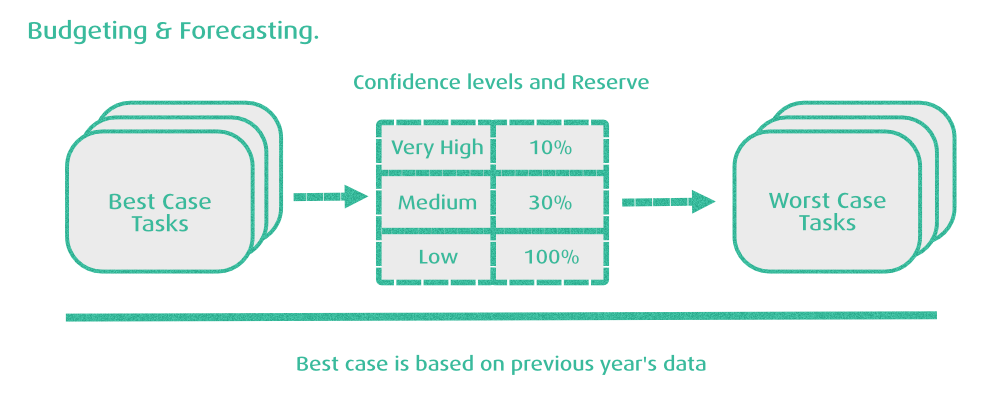
So once the spreadsheet fills up, we see items with various confidence levels and can summarise the project into a range figure - the best case, and the worst case scenarios.
Obviously, depending on the nature of the work, industry sector, and other factors like hourly rates, it becomes clear where the cost overrun could happen.
One needs to understand that once the task overrun happens, it overruns massively.
So our 100% reserve in this example can meltdown very rapidly for such a task, and the scale of confidence and reserves needs adjustment.
What is your experience with confidence levels and estimating reserves?
Our experience maps the possibility - it is not an exact science - and many times it is about scoping the work correctly to avoid a 400% budget blowout. But as I said - a critical task overrun can make a project go off track, blow the budget, and cause massive delays.
References:
- Mastering Financial Management, Brookson S., 1998, London
- Software Estimation: Demystifying the Black Art, McConnell, S, 2006, Washington