ABC of Management Accounting The fastest guide on the internet to build understanding of the Financial reporting Pavol Rovensky & Nick Sainsbury, ACA

  • Move Why do we need Management Accounts?
    Open Why do we need Management Accounts?

    Touch the pulse of the business by looking at its past performance and current trends.

    Every. business owner is faced with a periodic compliance obligation and submitting their Company Accounts to HMRC, and the Companies House.

    The documents required to comply with the obligations can be classified as a result of a process called “Financial Accounting”.

    Looking at the financial performance of any business from the perspective of a manager, the term “Management Accounting” is introduced.

    For the sake of brevity, we will not go deep into managerial function, but I always quote the late Peter Ashton, a local Chairman of the Federation of Small Businesses in the Bideford branch, who told me at the time:

    "It is rather challenging to plan for the next year or even a quarter taking into account the missing stability."

    Having said that, we clearly see that in an unstable environment, we just cannot afford to fly blind, and **we need to touch on the pulse of the business by looking at

    Why do we need Management Accounts? 483 words
  • Move 4 Accounting Concepts
    Open 4 Accounting Concepts

    As a software developer, most of the literature I've come across over the years, deals with accounting equations, and definitions of assets, liabilities and equity, in its fundamental form. The world of accounting revolves around these entities. However, there are Fundamental Accounting Concepts, which are not so well explained.

    The book [1], which I believe is a seminal work addressed for the needs of SME owners, and directors, brings a lot of clarity and explained these concepts in detail.

    Preparing this article, I can spot that the wording of the concepts and explanations have changed, I've found that the normative text started as SSAP2, through FRS18, and FRS102.

    I've heard the principles over the years, in personal communications with our company accountants, and also in the consulting sessions, which we attended over the years while working on ProudNumbers.

    As the author of the book states very poignantly on pg. 26, we become a nation driven by the profit and loss account. The up-to

    4 Accounting Concepts 495 words
  • Move Measuring operational effectiveness.
    Open Measuring operational effectiveness.

    The Profit&Loss statement is a financial report which differentiates 4 main categories to aggregate financial information and getting Gross-Profit, and Net-Profit figures.

    This classification is generally well known to SME business owners, and expressing it in relative percentages allows us to compare between different industries.

    To understand Profit and Loss, we define the 4 categories and derive the Gross-Profit and Net-Profit figures.

    Gross_Profit_and_Net_Profit.png Sales are the easiest part, as it describes the overall volume of activity. It doesn't include VAT.

    As the goods for sales need to be purchased or produced from raw materials, the P&L report contains 2 headings - Purchases of the goods, and Labour needed to be provided to create the product.

    Gross Profit is defined as

    GP = Sales - Purchases - Direct Expenses

    The Gross Profit will provide the raw effectiveness of the 'factory'. The computation

    Measuring operational effectiveness. 465 words
  • Move P&L report formats - by function, or by nature?
    Open P&L report formats - by function, or by nature?

    My exploration through the world of management accounting led me towards learning more about these 2 formats of the P&L statement.

    Speaking with a few consulting Management Accountants, it became clear that the 'default' chart of accounts used in most companies doesn't always capture the story behind the figures for a particular business.

    However, a slightly modified Chart of Accounts usually does, so the question for me was more like how to edit the Chart of Accounts easily and compute the P&L.

    ProudNumbers contain Chart of Accounts Editor, and I remember very well that coffee shop meeting in Torrington, where the idea was born and later implemented into our product around 2017.

    Recently I discovered that most of the US-based airline companies are using P&L (Income statement) based by nature, and that is our subject in this article.

    Both formats yield the same result in terms of Net profit before taxation. However, the P&L by nature shows the changes in inventories of finished goods, and

    P&L report formats - by function, or by nature? 467 words
  • Move Balance Sheet
    Open Balance Sheet

    The key concept of the Balance sheet is a snapshot of the business assets less liabilities and items of capital. The report as such is less understood as P&L by general business person. Learning more about how to interpret the balance sheet is exciting. Compiling the last few posts gave me an opportunity to learn more about management accounting, as I ever could hope for.

    Knowing the internals of reporting for accountants gives us - developers - an exceptional springboard into knowledge about business and how things work.

    The accounting convention used is called historic cost. So the value of assets is recorded at their original historic cost. Of course, current values are different and can be recalled for items such as land.

    Balance_Sheet.png

    Looking at the structure of the balance sheet, we see the following headings:

    • Fixed Assets
    • Current Assets
    • Current Liabilities
    Balance Sheet 490 words
  • Move Balance Sheet and Working Capital
    Open Balance Sheet and Working Capital

    The operating cycle of the business includes all activities which can be classified as input buying of the 'stock', adding value to it, and selling the products or services to generate profit (with associated activities to enable sales), followed by the cash collection from customers.

    The other cycle differentiated in the business activity is the investment cycle - purchasing tools, and means for production, or service delivery. We have described this process in the previous posts.

    Current_Assets.png

    The operating cycle is mapped in the Current Assets section of a balance sheet. The lines of the section are usually sorted according to their liquidity. This section allows us to understand working capital requirements, as we see shortly, understanding the length of the operating cycle is a key information point to know how much money the business needs to fund its operations.

    Assuming a very simple model, where a business needs 3

    Balance Sheet and Working Capital 508 words
  • Move Managing Debtors
    Open Managing Debtors

    Modern business relies on credit, and the majority of the companies offer credit terms to their customers or receive it from their suppliers.

    Customers who receive credit are known as debtors or receivables. Suppliers who provide their goods or services without receiving payment immediately are called creditors, or payables.

    Debtors are Assets, as they represent money to be received in the near future. The opposite is true for Creditors – they are Liabilities because you have an obligation to pay the received invoice at a later date.

    Managing carefully the time to collect payments, and paying bills when due, is a necessity.

    It needs to be seen that Debtors are not cash, and they cannot be used to fund immediate cash needs of the business.

    schema.png

    Each accounting software needs to allow users to issue or import the invoices and track payments made into Debtor accounts. Once the invoice has been paid by the customer (for Debtors), it ge

    Managing Debtors 480 words
  • Move Another look at Debtor's Days
    Open Another look at Debtor's Days

    Debtor Days is a key indicator to follow, and it can tell us a lot about the payment patterns of our customers, and the overall market health, when looking back over time.

    In principle, if your company Sales Payment T&C has a standard period of 30 days, then the collection period should be around 30 days as well.

    So the Debtor Days indicator will show with clarity, how much longer it actually takes on average for your company to collect the money. We don't need to imply how critical this information is, and the fact that money is being collected has on the company's cash flow.

    There are few established formulas differing only in their readability for a casual user, but [1] offers an easy way to calculate the indicator.

    First, we compute at "Sales per day".

    Sales per day = Total Annual Sales / 365
    

    The indicator itself is also known as "Days Sales in Debtors" or "Days Sales Outstanding".

    Debtor Days = Debtors / Sales per day 
    

    As we have mentioned, the ideal is to

    Another look at Debtor's Days 348 words
  • Move Looking at Return on Capital Employed (ROCE)
    Open Looking at Return on Capital Employed (ROCE)

    As business owners, we tend to look at the Gross profit, and Net Profit, eventually things like Debtors, and Creditors Days.

    While these KPIs are essentials, they plug in into a wider context defined as Return on Capital EmployedR (ROCE)

    ROCE = Profit before tax / Capital Employed
    

    A simple formula, with a deeper meaning behind. As the author explains in [1], we need to use share capital + reserves + long-term liabilities. All these figures are to be found on your balance sheet.

    It is necessary to understand that lenders could be actually funding your business, therefore the inclusion of the long-term liabilities.

    Sometimes we can use RONA - which is the same figure, as net assets are the same - fixed assets+current assets less current liabilities.

    It is almost a question who teaches you the concepts, but it is clear. Once we compute ROCE periodically, we can see a yardstick indication, especially compared with other businesses in the same industry.

    The infidelity in

    Looking at Return on Capital Employed (ROCE) 509 words
  • Move Profit and Loss account analysis
    Open Profit and Loss account analysis

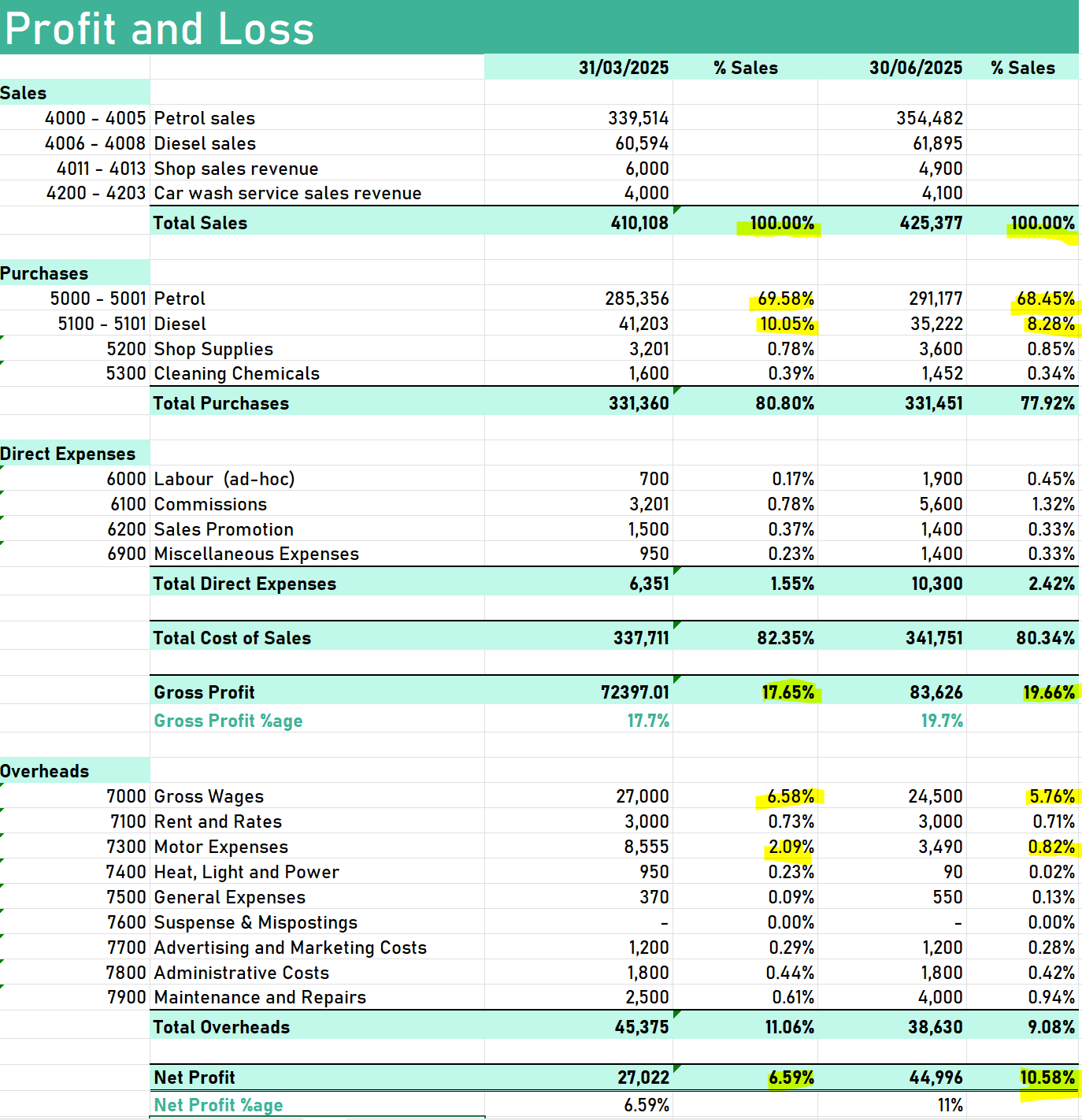
    One of the less known analyses is to look at your Cost of Sales, Direct Expenses, and Overheads, as percentages of Total Sales.

    We all are accustomed to the Gross Profit, and Net Profit, so we can apply the same formula for the other elements contributing to the Net-Profit result percentage.

    I've done that in my example, and over the years, I've been doing this analysis for my costs of software tools, server rental, and other production means.

    Similarly, one needs to know the percentages of overheads, such as office rent, power, and light, and motor account expenses.

    The attached image sums it up, as it shows a hypothetical forecourt, selling petrol, and diesel, together with a few other products.
    Profit_And_Loss.png

    Knowing how the costs are fluctuating as a percentage of total sales gives you a "yardstick" measure - quoting [1].

    To emphasise, we need to do this analysis in the time series—the example compares 2 quarters

    Profit and Loss account analysis 381 words
  • Move KPI revisited, again!
    Open KPI revisited, again!

    In my last post about KPIs, we looked at the Return of Capital Employed. Thanks all who contributed to that discussion under post, it helped me a lot in my understanding of the metrics.

    The good understanding of the domain helps us to develop quality software faster. The basic mathematics around accounting have been known to me for a long time, but some of the ratio concepts were not so familiar.

    Today I want to share some of the Balance Sheet ratios.

    Asset Turnover

    This indicates how well an organisation is using its assets to generate sales revenue.

    Asset Turnover = Sales / Capital Employed 
    

    The ratio is similar to ROCE, but it includes Sales, instead of Profits.

    The ratio is very dependent on the type of industry, and service industries should show higher values than manufacturing companies.

    The low ratio can indicate that the company is not generating suffcnt revenues in its sales.

    Current Ratio

    Current Ration = Current Assets / Current Liabili
    
    KPI revisited, again! 431 words
  • Move Getting to grips with Departmental Accounts
    Open Getting to grips with Departmental Accounts

    Departmental Accounting as an underused concept in the SME-s usage of accounting programs. Most businesses have some organisational structure, built around product or services, and it is underpinned by general administrative, marketing and sales functions.

    The easy way to capture the organisational structure for a business in its financial reporting is through the use of departments.

    The departments are defined tags, which are attached to transactions, when entering them into a double entry bookkeeping journal.

    In Sage 50, these tags can be set up, and number codes are used. As it happens, these numbers will exist in perpetuity, but as business conditions change, a business grows, so do the departmental numbers, and sometimes it can get confusing, especially when a need to retire the department arises.

    The departments are also called cost centres in the literature, and I believe that this term better explains what they represent. The cost centres associated with the production phases of the prod

    Getting to grips with Departmental Accounts 519 words
  • Move Computing Cash flow Statement
    Open Computing Cash flow Statement

    Being stacked into implementation of Cash flow Statement, I got a chance to learn the concept and mechanics myself. All accounting books out there put their attention to this crucial part of financial statements, but each author rightfully points his focus in his own way.

    The FRS1, and FRS102 normative gives us a clear picture on how we should report our cash flows from Operating, Investing, and Financing Activities.

    The goals to fulfill are twofold:

    • show cash generation and cash absorption in a well-structured manner

    • provide information about liquidity, solvency, and financial adaptability

    Cashflow_Schema.png

    The statement must tally up with the other two parts of Financial Statements

    • P&L - operating profit, and net profit, and the movement in net debt from Balance Sheet.

    The essence of the statement is to show where actual money comes from and where it goes. The increase/decrease in Stock/Debtors/Creditors is the k

    Computing Cash flow Statement 495 words
  • Move Lessons learned in estimating and budgeting
    Open Lessons learned in estimating and budgeting

    The perennial problem of estimating the cost of a larger project has been with me since around 2005. Once I joined the ranks on self-employment back in 2007, it became even more important to eliminate the guesswork and come to some methodical approach of estimating work to be done.

    Simultaneously, as we provide a simple budgeting tool for our clients in the ProudNumbers management accounts, there are many common traits between budgeting for business and estimating costs of the software project.

    Speaking about estimation methods, our natural reaction to the question "How long will it take?" is to give an answer, which usually matches our experience with a given problem.

    The duration of the past implementation of a similar solution, and some kind of reasonable reserve form the final figure. The answer always depends who is posing this question.

    Similarly, the business owner will relate to his previous year's trading results, in order to estimate a new financial plan and forecasted revenues.

    Lessons learned in estimating and budgeting 473 words
  • Move A practical estimation exercise
    Open A practical estimation exercise

    The idea of this post is to recap some of the key ideas from my previous post on Estimating and Budgeting.

    As most of us should, and hopefully will transition from that one figure estimating and budgeting mindset into a concept of a range with minimum and maximum cost for each line on the budgeting work sheet.

    As we call for simplicity, let's now try to think about an instruction set to create a best case/ worst case scenario estimate for our project.

    In the first instance we will need to think about splitting a bigger project into smaller manageable chunks.

    Once we split the project into tasks and line them up in the spreadsheet, we need to think about task overrun.

    Having said that, we may think about each task and first enter our best case figure into the spreadsheet. The best case figure is usually based upon our previous experience or knowledge of the same type of activity in the past.

    Once we have that best case number entered onto the worksheet, then we need to think to star

    A practical estimation exercise 582 words
  • Move Capitalising on software development.
    Open Capitalising on software development.

    As the intangible nature of software and its long-term benefits to the business are increasingly recognised, most of the time we need to find some more suitable model to capture these values in our accounting systems.

    The facts are certainly well known nowadays, and in most cases to account correctly, you need accountants working in the R&D space, knowing current legislation, and HMRC guidance.

    In principle there are 3 phases when recognising the cost of the software project, including R&D.

    These phases are

    • Preliminary R&D Phase - to be expensed
    • Technological Feasibility hase - to be expensed
    • Development until Product Release - to be capitalised
    • After Release Maintenance - to be expensed.

    Now let's little decipher the issue of capitalisation vs expense. In principle, the value, which has been created during a period of Development, can be recognised as a Fixed Asset. Again - this is an intangible asset with no physical existence, but the nitty-gritty of the legislation require

    Capitalising on software development. 539 words
  • Move More on intangible assets, and why their development is risky
    Open More on intangible assets, and why their development is risky

    We know that the intangibles are notoriously challenging to develop and commercialise successfully. Speaking with a friend who works as an accountant, we discussed my recent post "Capitalizing on Software Development". He asked why the probability of losing the investment was so high for software, compared to other types of investment into physical goods or services.

    Developing a technology, or even applying existing technologies to solve a problem in an innovative way, carries risks in terms of cost overruns, delays and failure to deliver value. We know all of these things from experience, but digging deeper reveals some interesting insights about how this risk manifests itself, which may help us understand what makes it different than developing tangible products.

    As I learned examining the literature reference, a lot of research in this are was done by Baruch Lev, professor at Stern School of Business New York University.

    Diagram.png

    Lev starts

    More on intangible assets, and why their development is risky 456 words
  • Move Looking deep into business cycle
    Open Looking deep into business cycle

    Understanding the cyclical nature of economic activity is important for many reasons, including own economic planning, business success, and strategy to be chosen.

    All businesses have two cycles: the capital investment cycle and the operating cycle.

    Schema_2_cycles.png

    The operating cycle, is straightforward - goods and services are bought in order to sell them later on at a profit. The efficiency of the operating cycle depends primarily on how fast the turnaround of goods and services the company is able to achieve. Obviously, the proportion of bad debts, solvency of the clients, and collection time of the issued invoices will affect the operating cycle.

    The capital investment cycle is a measure of how much is invested in the capital infrastructure in order that a business may carry out its operating cycle. A good example is any kind of manufacturing business which needs plant, and machinery ready, in order to execute their producti

    Looking deep into business cycle 480 words
  • Move The Tangibles-Intangibles Accounting Asymmetry.
    Open The Tangibles-Intangibles Accounting Asymmetry.

    The subtitle from the book [1] by Baruch Lev opens my next post on the series. In the last post we touched the 2 business cycles - investing, and operating.

    Valuing the intangible product, which may be a result of the investing cycle, and developed by a company during its period, could be a challenge for an investor or analyst.

    This claim is the concept of Lev's work, where he argues that the intangible assets are most time valued incorrectly. The intangible's valuation, in the SME scenario, could get more aberrated than in an international corporation.

    As we pointed out before, the inherent risk of loss on the investment into intangible asset development can be compensated with higher returns if it pays off. Lev examines a few bigger corporations and analyses their intangible investments. He concludes that investment into basic research brings much better return than other types of R&D - as compared to applied research.

    That is pertinent in the SME scenarios, where us as a micro company,

    The Tangibles-Intangibles Accounting Asymmetry. 522 words
  • Move What is ProudNumbers?
    Open What is ProudNumbers?

    My name is Pavol Rovensky, and I am a programmer working on B2B software for over 30 years now—since the summer of 1992.

    I also run my own company called Hexner Limited, and this organisation develops and markets ProudNumbers Management Accounts for Sage 50.


    ❓ What problem does ProudNumbers solve?

    Sage 50 reporting requires the user to run reports one-by-one, the export to Excel does not preserve the formatting and doesn’t generate sums in the shape of spreadsheet formulas.


    ❓ What does ProudNumbers offer?

    ProudNumbers allows generating all management accounts at once with the click of a button.

    All sums in the ProudNumbers spreadsheet can be drilled down into individual transactions.

    🧮 Furthermore, ProudNumbers internally opens past P&L Ledger to report on historical data, whether it is a past year, or 5 years ago. This is very useful for analysing trends and planning for the future.


    ❓ Can I export these spreadsheets to Excel?

    Yes, of course.


    ❓ Who is

    What is ProudNumbers? 413 words